Preventive maintenance extends equipment service life, reduces unplanned failures, and supports facilities in demonstrating reasonable care. Commercial facilities following industry best practice maintain equipment to manufacturer specifications and keep a complete maintenance log as a record of that care.
This schedule is a baseline program NCFET-certified technicians deploy in commercial facilities, organized by the four standard intervals — daily, weekly, monthly, and quarterly — and covering every major equipment category. Manufacturer manuals always take precedence where they specify different intervals or procedures; this framework fills the gaps and provides the structure. Home users can apply the monthly and quarterly tasks directly; daily and weekly facility tasks scale down to 'before and after each session' for home equipment.
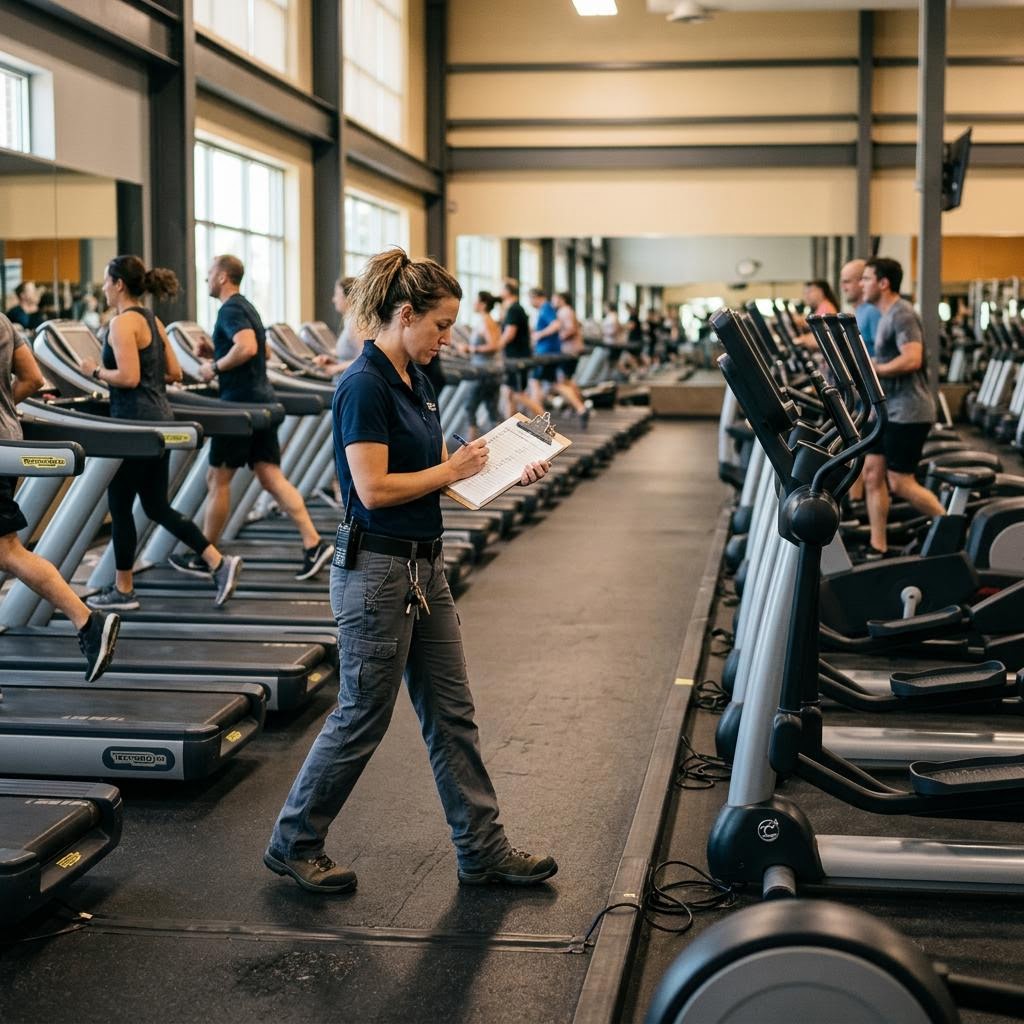
Daily checklist (facility staff — 5–10 minutes per zone)
No-tools walk-through that catches problems while they're cheap to fix:
- Wipe all contact surfaces with an equipment-safe disinfectant cleaner — sweat is mildly corrosive and degrades console membranes, grip tape, and upholstery seams over time.
- Walk the floor actively listening: a new creak, click, or knock noted and logged same-day gets fixed cheaply; the same noise ignored for two weeks becomes a service call.
- Verify every treadmill safety key (magnetic clip) is present, attached, and that the belt stops immediately when the key is removed. Log any unit that fails.
- Visual scan for frayed cables on selectorized machines, loose pedals, missing selector pop-pins, torn upholstery, or damaged handles — tag and remove from service anything that fails this scan.
- Check treadmill handrails and emergency stop buttons are secure and free of cracks.
Weekly checklist
Light-touch checks across all equipment categories:
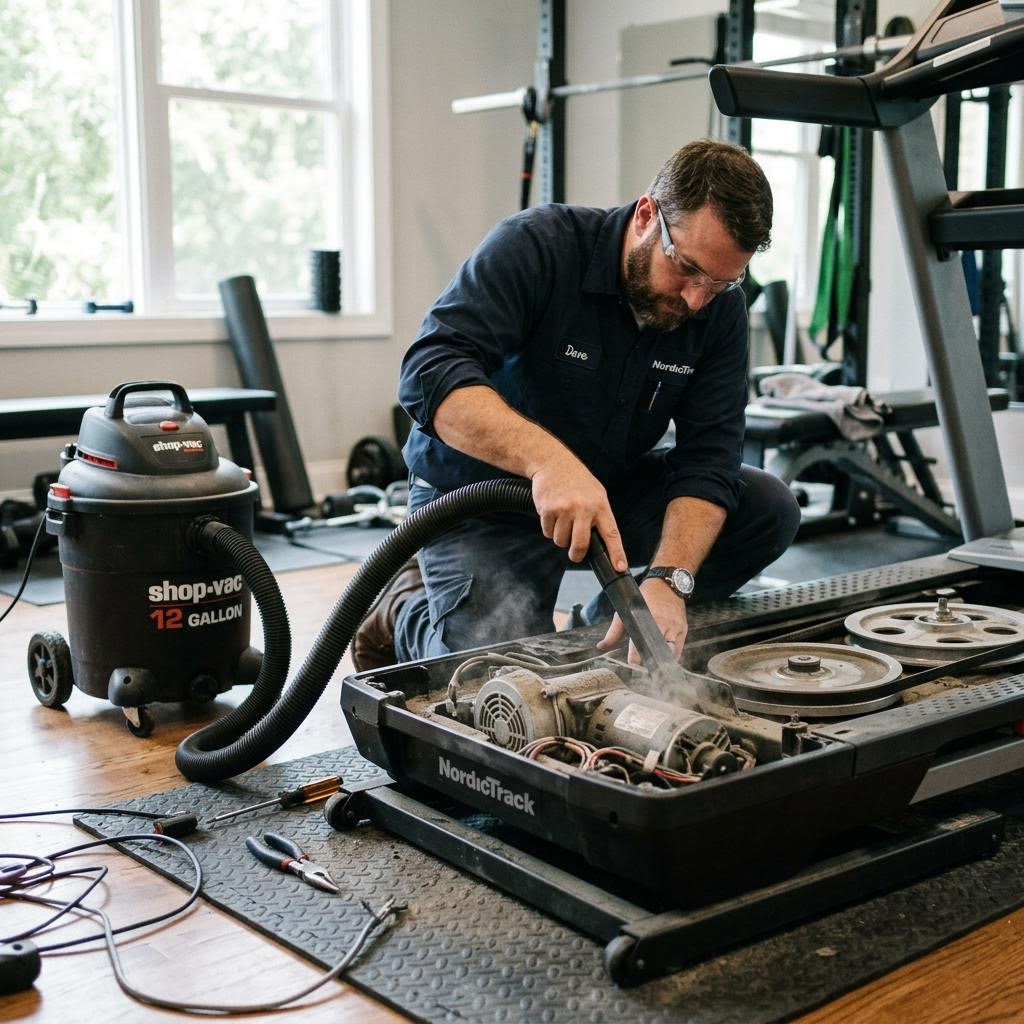
- Vacuum visible belt dust around and under treadmill and cardio equipment — accumulated belt dust under a treadmill is an early indicator of a deck that may need lubrication.
- Test all console buttons, heart-rate grip sensors, and display segments on cardio equipment; flag dead segments or non-responsive buttons for maintenance.
- Spin-check accessible pulleys on cable and functional trainer stations with the weight stack pinned — each pulley should spin freely and silently; drag or grinding flags a bearing for service.
- Confirm cables ride the center of every visible pulley groove; a cable riding a flange needs immediate attention.
- Check treadmill walking belt tracking — any visible drift off-center should be corrected per the manufacturer's adjustment procedure for that model.
- Torque-check pedal bolts and crank arm bolts on the highest-use bikes and ellipticals; crank bolt loosening is a recurring finding on heavy-use units.
Monthly checklist (technician level)
First technician-level inspection tier — these tasks require training to perform correctly:
- Treadmills: deck lubrication check (touch test at the deck center; lubricate silicone-system decks if dry per the manufacturer's specification), belt tension check per the service manual's specified method, safety stop function verification, and amp-draw spot-checks on high-mileage units against the service manual specification.
- Strength equipment: full cable inspection to rejection criteria on every cable (broken strands, jacket damage, kinks, corrosion, termination movement), guide rod cleaning and re-lubrication with manufacturer-specified product, frame bolt torque sampling at high-stress joints, and upholstery condition.
- Ellipticals: pivot joint and ramp roller inspection, stabilizer leveling, resistance sweep through the full programmed range on console-controlled units.
- Exercise bikes: resistance system function test (friction pad inspection or servo motor sweep per system type), pedal and crank torque, seat-post clamp security.
- Documentation: log every machine's findings by asset ID — the log is simultaneously your trend data and your liability record.
Quarterly checklist (qualified technician — in-house if certified, contracted otherwise)
Deep service that requires technical training and in some tasks electrical safety knowledge:
- Treadmills: motor compartment vacuum and full inspection (belt debris insulating the MCB is a common contributor to thermal error codes), drive belt condition and tension check per the service manual, roller and idler bearing inspection, full speed and incline calibration, elevation motor actuator service.
- Strength equipment: pulley and bearing replacement as indicated by monthly inspection findings, cable replacements on condition, weight stack alignment and guide rod straightness, structural weld inspection at high-stress joints on cable crossovers and functional trainers.
- Electrical: dedicated circuit verification for treadmills (confirm no shared loads), power cord and plug inspection for heat discoloration or damage, GFCI function test where installed, cord-to-machine strain relief integrity.
- Firmware and console: apply manufacturer-published updates where available; verify calibration after any console update.
- Documentation: record all findings, parts used, and technician credential alongside the date — quarterly records provide the deepest technical evidence of a facility's maintenance program.
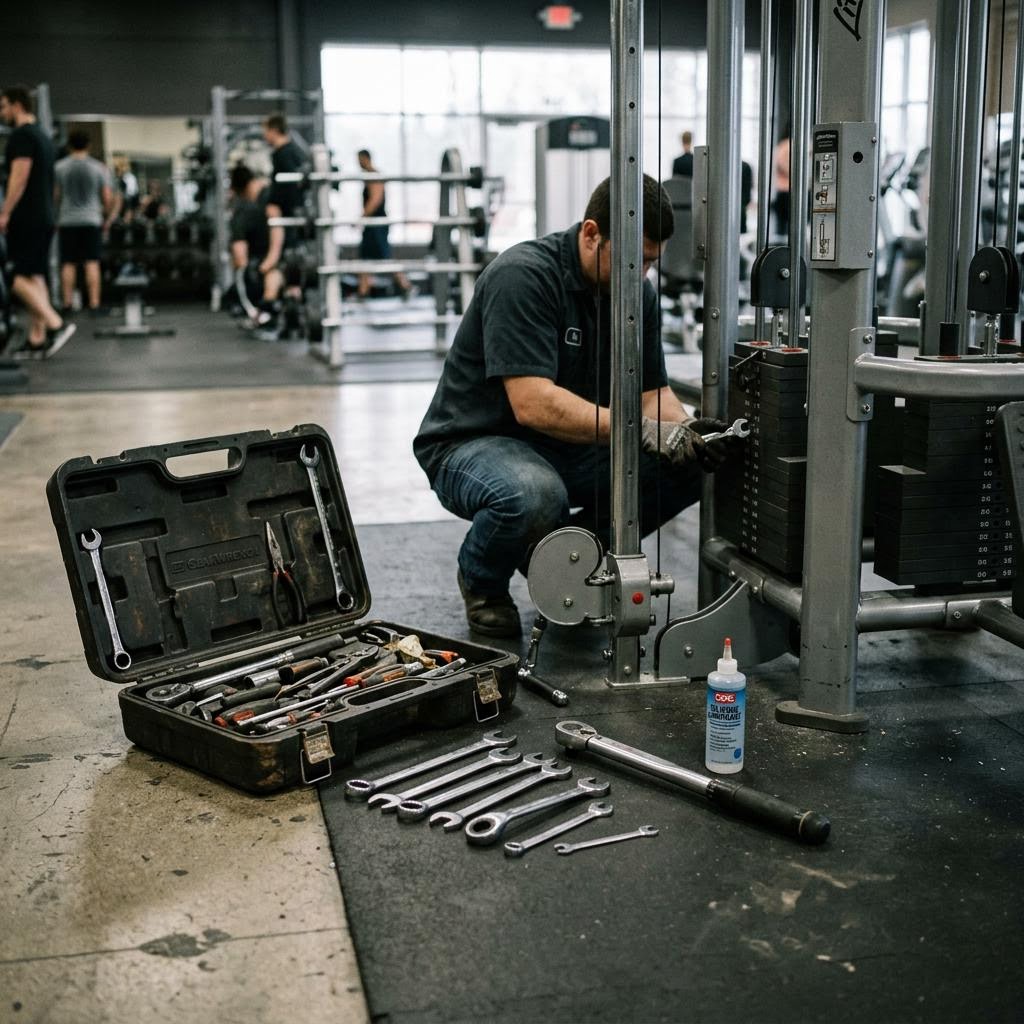
Why documentation is half the maintenance program's value
A maintenance program without records provides almost no protection and limited operational value. Every inspection event should record: the date, a unique machine asset ID, each line item's result, any corrective work performed with parts used, whether the machine was tagged out of service and when it was returned, and the technician's full name and credential. Digital maintenance platforms make this practical at scale; a printed binder per machine achieves the same result.
Trend data from the log — rising amp draw on a particular treadmill, a cable station that has needed two cables in six months — tells you when to escalate preventive action before a failure. A complete maintenance record also supports demonstrating the standard of care exercised if questions arise. Facilities increasingly specify that the person performing technical maintenance holds a verifiable industry credential, which is precisely the role NCFET certification fills.
Frequently Asked Questions
How often should commercial gym equipment be serviced?
Layered intervals: daily staff walk-throughs and cleaning, weekly light inspection checks, monthly technician-level inspections (cable rejection checks, belt lubrication and tension, resistance system function, torque checks), and quarterly deep service by a qualified technician (motor compartments, calibrations, electrical checks, bearing inspections). Manufacturer manuals override this baseline where they specify more frequent service for a specific model.
What is on a daily gym equipment maintenance checklist?
Daily tasks are fast and require no tools: wipe all contact surfaces with equipment-safe cleaner, walk the floor listening for new noises, verify every treadmill safety key is present and stops the belt, and visually scan for frayed cables, loose pedals, missing pop-pins, or torn upholstery. Anything questionable gets tagged out. This daily scan is what prevents a small developing fault from becoming a member injury.
What maintenance does a home treadmill actually need?
Four things address the most common failure causes: keep it clean and vacuumed regularly (especially the motor compartment), lubricate the deck per the manufacturer's system type and interval, keep the walking belt centered and tensioned per the service manual, and plug it into a dedicated outlet — not a shared circuit or power strip. Following the manufacturer's maintenance schedule helps avoid the most frequent home treadmill failures.
Does preventive maintenance really save money?
Yes, substantially. The most common commercial treadmill repair cascade — a dry deck causes elevated motor current, which stresses the MCB, which then fails — begins with skipped deck lubrication. Catching the dry deck at a monthly inspection costs a service visit and lubricant; missing it can result in a belt replacement, MCB replacement, and potentially a motor replacement. Facilities running documented PM programs also defer capital equipment replacement by extending useful equipment life.
Who is qualified to perform gym equipment preventive maintenance?
Daily and weekly tasks are appropriate for trained facility staff. Monthly and quarterly technical work — cable rejection decisions, lubrication system identification, electrical circuit checks, calibration procedures, and drivetrain service — should be performed by a trained and credentialed technician. NCFET certification provides a verifiable national standard for that qualification; any credential can be confirmed at ncfet.com/verify.
Standards & References
- ASTM F2276 — Standard Specification for Fitness Equipment
- OSHA — General Duty Clause, Section 5(a)(1) — The general workplace-hazard duty that applies to staffed fitness facilities as employers.
This guide is provided as a free educational resource by NCFET and its certified technician team. Always follow your equipment manufacturer's service manual, and leave line-voltage electrical work to qualified professionals. You are welcome to cite or link to this guide; please attribute it to the NCFET certified technician team and link to this page.
Related Guides
Treadmill Deck Lubrication: The Complete Professional Guide
Read guideGym Cable Machine Inspection Guide: Rejection Criteria and Cable Replacement
Read guideCommercial Gym Equipment Safety Inspection Checklist
Read guideFitness Equipment Electrical Safety: Circuits, GFCI, Surge Protection, and Multimeter Diagnostics
Read guideNeed a professional? Or want to become one?
Find qualified service providers in the NCFET directory, verify any technician's credential at ncfet.com/verify, or start your own path to national certification.