

When an exercise bike's resistance stops working, the correct diagnostic approach depends entirely on which type of resistance system the bike uses — and there are four fundamentally different technologies, each with its own failure modes. Friction systems use a pad pressing on the flywheel. Manual magnetic systems move a magnet carrier by a knob with no electronic control. Servo magnetic systems use a console-controlled small motor to position the magnet carrier. Electromagnetic systems vary coil current electronically with no mechanical movement at all. Treating a servo magnetic problem like a friction pad problem — or vice versa — wastes time and parts.
This guide from the NCFET certified technician team covers all four systems, their common electronic and mechanical failure modes, and the professional diagnostic sequence for each. Identify your system type first using the section below, then follow the corresponding path.
Identify your resistance system before diagnosing
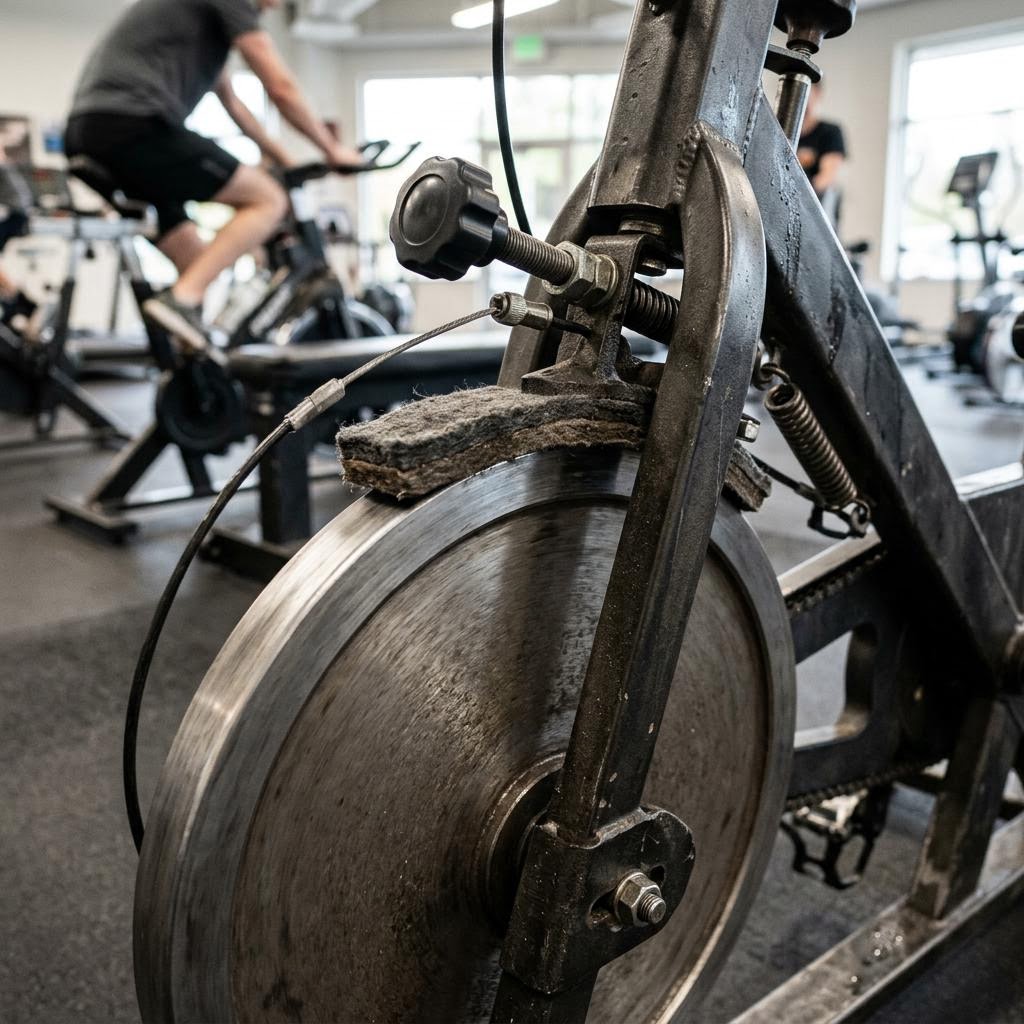
Friction systems (many spin bikes and older indoor cycles): a felt, leather, or composite pad physically presses against the flywheel rim via the tension knob. You can see and feel the pad — it sits directly adjacent to the flywheel with visible contact. Manual magnetic systems (common on mid-range spin bikes): the tension knob mechanically moves a magnet carrier closer to or farther from the flywheel with no electronic components involved. Servo magnetic systems (standard on most upright and recumbent bikes with a digital console): the console sends a signal to a small servo or stepper motor that positions the magnet carrier through a cable or gear linkage. Electromagnetic systems (high-end commercial bikes and smart trainers): current through a coil generates the braking field — no moving parts, resistance is purely electronic.
If you have a console with programmable resistance levels and the bike plugs in or has a battery, you almost certainly have a servo magnetic or electromagnetic system. If resistance is set by a physical knob only, it is either friction or manual magnetic.
Friction systems: pad wear, glazing, and contamination
Friction resistance fades gradually as the pad wears down, and abruptly when the pad glazes or becomes contaminated. Inspect the brake pad with the guard removed and the bike unplugged: a worn pad has visible height reduction compared to its new-state profile. A glazed pad has a shiny, hardened face that no longer bites the flywheel. A contaminated pad — from oil or lubricant migrating to the flywheel contact surface — may look normal but provides almost no braking.
Pads are inexpensive consumables; replace rather than attempt to resurface or clean when in doubt. Never apply any lubricant near a friction flywheel contact surface — oil contamination is very difficult to fully reverse. After pad replacement, check that the tension knob mechanism translates its full rotation into smooth pad travel; a bent linkage or stripped tension knob pivot reduces effective braking range even with a fresh pad.
Manual magnetic systems: knob mechanism and carrier alignment
Manual magnetic resistance requires no electronics — the knob directly moves the magnet carrier closer to (more resistance) or farther from (less resistance) the flywheel rim. When it stops working, the failure is mechanical: the cable or linkage connecting the knob to the carrier has stretched, disconnected, or the carrier is jammed on its guide rails.
With the bike unplugged and the guard removed, rotate the tension knob through its full range while watching the magnet carrier. If the carrier moves smoothly but resistance does not change, inspect the magnet carrier for a missing or detached magnet block. If the carrier does not move, the cable is broken or the linkage is disconnected at the knob end. If the carrier moves only partway, the guide rails are binding — clean the rails and check for bent or out-of-alignment guide pins.
Servo magnetic systems: motor, cable, potentiometer, and calibration
Servo-controlled resistance has the longest diagnostic chain: console → communication wiring → servo motor → linkage or cable → magnet carrier → position feedback potentiometer back to the console. A fault anywhere in this loop can present as 'resistance not working.' Enter the bike's service or engineering mode (sequence is model-specific — consult the service manual) and command resistance to minimum and maximum while observing the servo motor's behavior.
If the servo motor does not move at all: check the motor connector and wiring harness continuity before condemning the motor or console. A disconnected harness is a common post-service finding. If the motor moves but pedaling effort does not change: the linkage cable has stretched past its adjustment range, snapped, or the magnet carrier is mechanically jammed. Replace the cable and inspect the carrier guide rails. If the motor moves continuously back and forth without settling: the position-feedback potentiometer inside the servo assembly has likely failed; it can no longer report carrier position to the console, so the console keeps commanding corrections.
After replacing a servo motor, linkage cable, or potentiometer, always run the resistance calibration routine from the service manual. Calibration teaches the console the carrier's physical endpoint positions. Skipping calibration is the most common reason a new part 'doesn't fix the problem' — the console is commanding positions that don't correspond to the machine's actual mechanical range.

Electronic and electromagnetic systems: control board and coil diagnostics
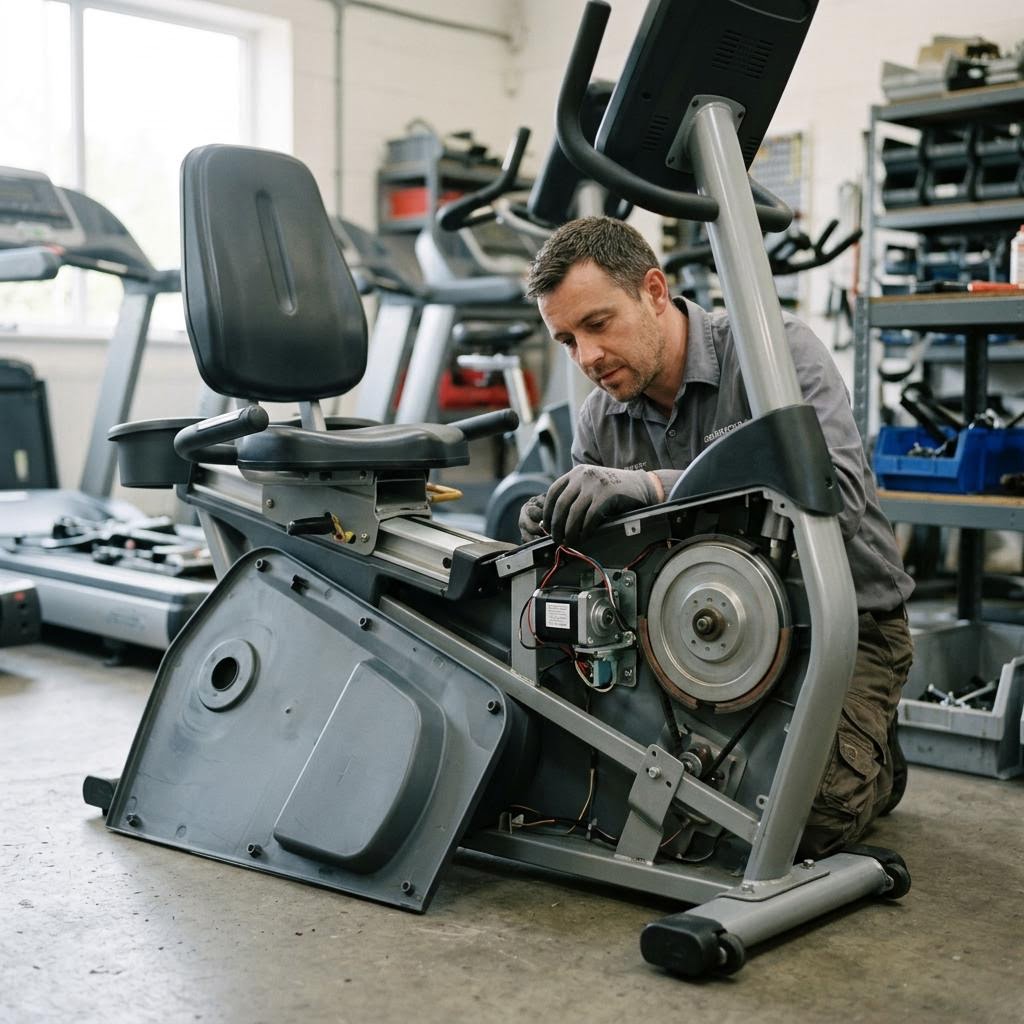
On electromagnetic systems, resistance is set by varying current through a brake coil — there is no mechanical carrier movement. Console faults, coil connection failures, and control board faults all present as no resistance at any level or resistance fixed at one level regardless of console commands. These systems require board-level diagnosis involving live voltage measurements and are technician territory.
Self-powered commercial bikes generate their own electricity as the rider pedals; the resistance coil is driven from this generated power. Low or absent resistance at low cadence on these machines is a design characteristic, not a fault — the generator output at slow pedaling speed is insufficient to create strong braking. Genuine faults on self-powered bikes present as no resistance at any cadence or wildly erratic resistance regardless of effort level, and typically trace to the control board, rectifier, or coil connection. Internal voltages on self-powered bikes can reach line-equivalent levels while being pedaled — board-level work must be performed by a qualified technician following proper safety procedures.
Frequently Asked Questions
Why did my exercise bike suddenly lose all resistance?
On a friction bike, the brake pad has likely worn through, detached, or the tension linkage disconnected. On a manual magnetic bike, the magnet carrier linkage may have come loose from the knob. On a servo magnetic bike, a servo cable or servo motor may have failed. Inspect the brake assembly at the flywheel with the guard removed and the bike unplugged — sudden total loss of resistance is commonly a visible mechanical failure, though electronic causes are also possible on servo and electromagnetic systems.
My bike's console changes resistance levels but the pedaling effort never changes. What's wrong?
The console is commanding the servo but the mechanical chain is not delivering it. Most likely causes: the linkage cable between the servo motor and magnet carrier has stretched past its adjustment range or snapped, the magnet carrier is mechanically jammed on its guide rails, or the servo motor has failed. Enter service mode and watch whether the servo motor moves when resistance is commanded — if it moves but effort does not change, the fault is downstream in the linkage or carrier, not in the electronics.
What causes the resistance to jump or be erratic on an electronic bike?
Erratic resistance on a servo magnetic bike most commonly means the position-feedback potentiometer is failing — its resistance output is noisy or drops out, causing the console to misread carrier position and continuously hunt. Less commonly, a harness wire is intermittently open from a fatigue crack at a connector or routing point. Erratic resistance on an electromagnetic system typically indicates a control board fault.
Do magnetic resistance systems wear out?
Eddy-current braking is contactless, so the magnets themselves experience minimal wear under normal use. What does fail over time are the mechanical and electronic components around them: servo motors, position-feedback potentiometers, linkage cables, and carrier pivot pins. These components are serviceable; the magnetic elements tend to outlast the rest of the drive system.
Can I fix exercise bike resistance myself, or do I need a technician?
Friction pad replacement, manual magnetic cable reconnection, and linkage cable replacement are within reach for a confident DIYer with the correct parts and the service manual's routing diagrams. Servo motor replacement and the calibration procedure that follows require service mode access and are best left to a technician if you are unfamiliar with the bike's engineering mode. Any diagnosis involving live internal voltages — electromagnetic systems, self-powered bikes — requires a qualified technician.
Standards & References
- ASTM F2276 — Standard Specification for Fitness Equipment — General design and safety requirements for stationary fitness equipment.
This guide is provided as a free educational resource by NCFET and its certified technician team. Always follow your equipment manufacturer's service manual, and leave line-voltage electrical work to qualified professionals. You are welcome to cite or link to this guide; please attribute it to the NCFET certified technician team and link to this page.
Related Guides
Elliptical Clicking, Squeaking, or Grinding: A Technician's Noise Diagnosis Guide
Read guideFitness Equipment Electrical Safety: Circuits, GFCI, Surge Protection, and Multimeter Diagnostics
Read guideGym Equipment Preventive Maintenance Schedule: Daily, Weekly, Monthly, and Quarterly Checklist
Read guideNeed a professional? Or want to become one?
Find qualified service providers in the NCFET directory, verify any technician's credential at ncfet.com/verify, or start your own path to national certification.